IAM continues tracking water permitting, plumbing code concerns, and other policy issues affecting Minnesota irrigators.
The 2026 Minnesota legislative session brought continued attention to water use, permitting, infrastructure, agriculture policy, and regulatory issues that could affect irrigators across the state.
For the Irrigators Association of Minnesota, the session included direct advocacy on water appropriation permit language, continued monitoring of data center water use discussions, and a new regulatory concern involving possible State Plumbing Board rule changes that could affect agricultural irrigation systems.
While several major state issues moved through the Legislature in the final weeks of session, many of the items most directly tied to irrigation policy remained unresolved or will require continued attention beyond the 2026 session.
IAM will continue working with its lobbyist team, Agri-Growth, and other partners to monitor these issues and advocate for practical, workable policies for Minnesota irrigators.
IAM/Agri-Growth bill receives House committee hearing
One of IAM’s top priorities this session was HF 3236, the IAM/Agri-Growth bill related to water appropriation permits.
The bill was heard in the House Environment and Natural Resources Finance and Policy Committee on March 24. IAM President Jake Wildman testified on behalf of irrigators, sharing the importance of clear, fair, and workable water permitting policy for agricultural producers.
Following the hearing, Darin Broton sent revised language to Jason Moeckel at the Minnesota Department of Natural Resources to address a concern raised during committee discussion by Rep. Rick Hansen.
However, the bill was not heard in the Senate Environment Committee. In addition, there was not an Omnibus Environment Policy bill this session, which limited the available paths for the language to move forward.
IAM worked with Agri-Growth to explore possible options, including whether the language could be considered as a floor amendment. While the issue did not receive a full resolution during the regular committee process, IAM continues to view water appropriation permit policy as a priority.
The conversation around HF 3236 helped keep irrigators’ concerns in front of legislators and agency officials, and IAM will continue evaluating next steps with its partners.
Plumbing code concern could affect agricultural irrigation
IAM is also reviewing a regulatory issue brought forward by Felipe Illescas of the Minnesota Nursery & Landscape Association.
MNLA raised concerns that the State Plumbing Board may be pursuing changes to the plumbing code that could define irrigation as plumbing. According to the concern shared with IAM, possible impacts could include requirements for ANSI-certified components, installation by a licensed plumber, and other regulatory changes.
MNLA believes the proposed changes could apply to agricultural irrigation as well.
This issue is especially important because it could affect farmers, irrigation dealers, system installers, and service providers. Agricultural irrigation systems are highly specialized, and any new regulatory requirements could have significant cost, workforce, and implementation impacts.
IAM is reviewing the information shared and is seeking feedback from members.
Members who believe these potential rule changes could affect their farm, irrigation business, dealership, or installation work are encouraged to share their concerns with IAM.
Other water and groundwater bills monitored
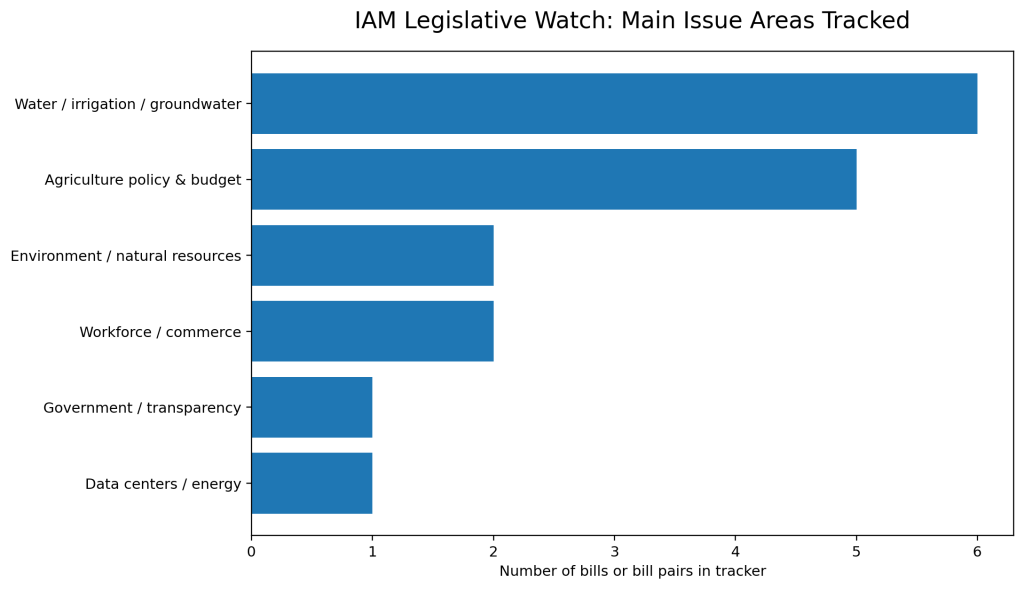
In addition to HF 3236, IAM tracked several other water and groundwater-related proposals during the session.
HF 4019 / SF 4192 would expand eligibility criteria for appropriation permits from the Mt. Simon-Hinckley Aquifer. The House version had advanced to second reading as of the May 1 bill tracker, while the Senate version had been referred to the Environment, Climate, and Legacy Committee.
IAM also monitored HF 3793 / SF 3852, which would require certain large groundwater users to apply for their own water-use permit instead of modifying an existing municipal permit. The proposal received committee activity in both chambers and remained an issue of interest because of its connection to water-use permitting and large-volume groundwater users.
These bills reflect a broader trend at the Capitol: water policy is receiving increasing attention, and future discussions around groundwater, permitting, municipal systems, and large-volume users may continue to shape the policy environment for irrigators.
Data center water use remains on IAM’s radar
Data centers were also part of IAM’s legislative watch list this session.
HF 4153 / SF 4681 included provisions related to preapplication evaluations of water appropriations for data centers, along with energy and tax-related provisions.
IAM monitored these discussions because large data centers can raise significant questions about water demand, local infrastructure, energy use, and permitting. Even when these projects are not directly connected to agricultural irrigation, they can shape broader water policy conversations.
As data center proposals continue to emerge across Minnesota, IAM will keep watching how lawmakers, agencies, local governments, and communities approach water-use review and permitting.
For irrigators, the key concern is consistency. Agricultural water users need a permitting system that recognizes the importance of food production and treats water-use decisions with fairness, science, and long-term planning.
Irrigation installer licensure proposal introduced
IAM also tracked HF 4164, which would exempt irrigation system installers from power limited technician licensure requirements.
The bill was introduced and referred to the House Workforce, Labor, and Economic Development Finance and Policy Committee.
Although the bill did not appear to move through the same level of committee discussion as some other proposals in the tracker, the topic remains important for irrigation businesses and installers.
Licensing and workforce rules can directly affect the ability to install, service, and maintain irrigation systems. IAM will continue monitoring any future proposals that could impact irrigation system installers, dealers, and service providers.
Agriculture policy and budget bills also tracked
Several broader agriculture policy and budget bills were also included in IAM’s legislative tracking list.
These included SF 4561 / HF 4350, the omnibus agriculture policy bill, and SF 5073 / HF 4885, the agriculture, broadband, and rural development policy and supplemental appropriations bill.
While these bills were not specific to irrigation, they were important to monitor because agriculture policy, state agency funding, and program decisions can affect farmers and rural communities.
IAM’s legislative work often includes both direct irrigation issues and broader agriculture policy issues that could affect the operating environment for members.
What the session means for IAM members
The 2026 session showed that irrigation policy continues to intersect with several larger issues at the Capitol, including water supply, groundwater management, construction and licensing rules, data center development, and agricultural infrastructure.
For IAM members, the most important takeaway is that many of these issues are not finished.
HF 3236 helped advance the conversation around water appropriation permits, but more work remains. The State Plumbing Board issue may require close attention from members and industry partners. Data center water-use discussions are likely to continue. Licensing and installer issues may also return in future sessions or regulatory conversations.
IAM will continue tracking these topics and working to ensure that irrigators have a voice in policy decisions that affect their operations.
IAM will continue the work
The 2026 session may be over, but the work on irrigation policy continues.
IAM will keep working with its lobbyist team, Agri-Growth, MNLA, state agencies, legislators, and other partners to monitor water policy, regulatory proposals, and agricultural infrastructure issues.
As these conversations continue, IAM’s focus remains clear: protecting the ability of Minnesota irrigators to use water responsibly, maintain reliable irrigation systems, and operate under practical, science-based policy.
Members with questions or feedback are encouraged to contact IAM.
Tracked bills at a glance
| Bill | Short title | Key chamber actions in IAM tracker | Final status by end of regular session | IAM impact |
|---|---|---|---|---|
| HF 3236 / SF 3423 | Water appropriations permit requirements modified | HF 3236 had a March 24 House Environment hearing; IAM reported no Senate Environment hearing for the companion. | No chapter law under either bill number in the official 2026 regular-session laws list. | IAM’s signature permit bill; stalled but likely groundwork for 2027. |
| HF 4019 / SF 4192 | Mt. Simon-Hinckley aquifer permit eligibility expanded | HF 4019 reached House second reading on April 7; SF 4192 was referred in the Senate. | No chapter law under either bill number. | Would have broadened aquifer appropriation-permit eligibility. |
| HF 3793 / SF 3852 | Large groundwater users required to seek their own permit rather than modify a municipal permit | HF 3793 received multiple House hearings; SF 3852 moved in Senate Environment, Climate and Legacy. | No chapter law under either bill number. | Significant for agricultural and other high-volume users tied to municipal systems. |
| HF 4153 / SF 4681 | Data-center water preapplication evaluations and related exemptions | HF 4153 was introduced and heard in House Energy; SF 4681 was referred in the Senate. | No chapter law under either bill number. | Signals continued pressure on water-appropriation policy from data-center growth. |
| HF 4164 | Irrigation system installers exempted from power-limited technician licensure | Introduced March 12 and referred to House Workforce, Labor, and Economic Development. | No chapter law under this bill number. | Direct compliance relevance for irrigation installation work. |
| SF 4561 / HF 4350 | Omnibus agriculture policy | Senate bill passed as amended on April 20; House bill reached second reading April 7. | No chapter law under these exact bill numbers. | Important vehicle for packaging ag priorities, but not enacted under these numbers. |
| SF 5073 / HF 4885 | Omnibus agriculture, broadband, rural development policy and supplemental appropriations | Senate bill was amended and re-referred to Finance; House bill was introduced and sent to Rules. | No chapter law under these exact bill numbers. | Shows supplemental ag spending remained in play, but not as passed standalone law here. |
| HF 3426 / SF 3857 | Environment and natural resources trust fund | HF 3426 passed the House April 30; Senate companion had reached second reading earlier. | Enacted as Chapter 104. | The only exact watch-list bill number from IAM’s May tracker that clearly became law. |

