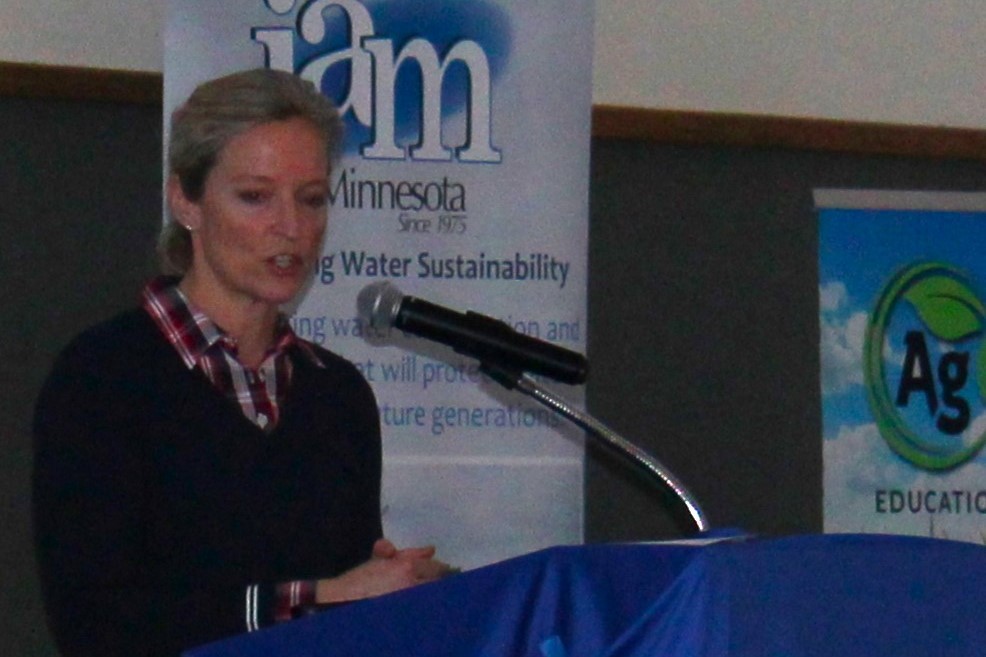
Smith outlines changes to DNR enforcement authority, emphasizing protection of Minnesota’s water supply.
At the 49th annual meeting of the Irrigators Association of Minnesota (IAM), Katie Smith, Director of the Ecological and Water Resources Division with the Minnesota Department of Natural Resources (DNR), addressed attendees regarding significant changes to the state’s water enforcement measures.

Smith highlighted the developments stemming from the 2023 legislative session, which DNR sought to provide the agency with enhanced enforcement authority. According to Smith, these changes are aimed at “addressing violations related to water appropriation without the necessary permit, with the overarching goal of safeguarding water resources for fish and wildlife habitats, domestic water supplies, and the benefit of current and future generations of Minnesotans.”
Smith explained key modifications to the DNR’s existing Administrative Penalty Order (APO) authority. The original APO authority, granted in 2014, allowed the issuance of penalties up to $20,000 for violations related to water appropriation. However, Smith said concerns arose at the agency regarding the adequacy of these penalties to deter violators, especially since they were capped and had to be forgiven if violations were corrected.
To address these concerns, DNR lobbied for the new law, which provides the agency greater discretion in calculating penalties, increases the APO cap to $40,000, and requires penalties to be paid for serious or repeated violations. Smith emphasized that “these changes aim to ensure the protection of Minnesota’s water supply, create a fair playing field, and hold violators accountable.”
While the APO plan revision was not mandatory with the recent changes, the DNR has engaged in discussions with stakeholders to be transparent about its intended use of the APO and to solicit input for consideration. IAM President Jake Wildman and Vice President Anna Bregier have been actively involved in these dialogues with the DNR, and will continue providing input for the APO plan.
In addition to the APO changes, the Minnesota DNR lobbied for new tools, akin to those of the Minnesota Pollution Control Agency (MPCA), to address various violation scenarios. These tools can be applied to situations not warranting a penalty, requiring prolonged corrective action timeframes, benefiting from negotiations with a permittee, or warranting higher penalties due to egregiousness.
Smith reiterated the DNR’s goal of achieving compliance, noting that “most water users comply with the law and hold a DNR water appropriation permit.” Smith stated the DNR emphasizes education as the first step to correct noncompliance and prefers achieving compliance through cooperation. “The use of APOs is expected to be infrequent, with non-forgivable penalties reserved for egregious or repeated violations,” she said.
When asked about how the DNR would ensure fair and consistent application of enforcement tools across the state, Smith said the DNR is modifying and developing programmatic guidance, creating a decision-making process for selecting the appropriate tool, and training staff accordingly. Smith emphasized that any “APO appealed by a party would require the DNR to prove the violations occurred and that the penalty was reasonable.”
In closing, Smith encouraged irrigators and agricultural groups to contact the DNR with questions or to report known or potential issues, highlighting the agency’s role in providing guidance and assistance to avoid noncompliance. Katie Smith can be reached by email katie.smith@state.mn.us or by phone 651-342-9227.
 IAM
IAM 